26.5.12

*

Film, Memory and the Legacy of the Spanish Civil War
Resistance and Guerrilla 1936-2010
by Mercedes Maroto Camino
Film, Memory and the Legacy of the Spanish Civil War reconstructs the legacy of the Spanish Civil War through an investigation of the anti-Franco guerrilla of the 1940s and 1950s. The book explores the memory of Spanish resistance fighters and their civilian supporters, concentrating on their cinematic representations in films and documentaries released between 1953 and 2010. This research fits within the emerging comparative field of Memory Studies, which has grown considerably in the last two decades. Along those lines, the efforts of civil society to understand and come to terms with the past have gathered momentum in twenty-first century Spain. One visible outcome of this determination has been the recovery of corpses from unmarked graves, which has been accompanied by a renewed interest in the cultural, historical, legal and archaeological traces of the millions who suffered under Franco's protracted dictatorship. This book sheds light especially on the silent roles played by women and children in the struggle against fascism.


18.5.12

*

Courts investigate baby thefts in Spain

[...]

According to historians and human rights activists, the 1939-1975 dictatorship of General Francisco Franco systematically took children away from parents who supported the 1931-1936 Republican government or who fought on that side during the 1936-1939 civil war.

But there is evidence that the trafficking of babies continued not only during the transition to democracy after Franco’s death in 1975, but until as late as 1990. 


[...]

So far, 18 graves have been exhumed in the search for stolen children, and child remains have only been found in three of them – the rest of the coffins were empty, or contained the bones of adults or animals.

full article here

15.5.12

*


El País in English
14.05/12

"Memory is not restricted to the past, but is a guarantor of the future." 
Nicolás Sánchez Albornoz

[...]

Q. Given what you say, as well as the controversy over the sentence handed down to Judge Garzón, what do you think should be done regarding Historical Memory?
A. First, all the cards should be laid on the table. Everything must come out, and that's what we have historians for. The post-Franco state has taken great care to ensure access to government and military sources has been closed. Historians have made great strides but they haven't managed to clarify everything. First, the truth has to come out and after that it must be made public. Finally, the descendants of the victims must be given closure.

Q. The issue of Historical Memory and the Garzón case prove that Francoism is not dead. In that sense, the judge is a new victim.
A. Of course. Although I would change your wording ever so slightly. It's true that Francoism has not died out, but you have to add that what remains just represents a segment of the population, because other groups will not have it. Unfortunately, it is quite a large segment that is still very active in the social and political apparatus of the country. But it must be acknowledged that the majority of Spaniards are disgusted by these things, and in general, Spaniards are much better than those nuns who stole the babies.

[...]

A. [...]There is a return to certain Francoist roots in society, and that is worrying. A very unpleasant Spain is surfacing. The big difference from the Franco regime is that an authoritarian regime designed by a party was imposed, and so far in Spain, the principle of free elections is being upheld. So at least there is some hope.

Q. Do you think the Republican spirit still lives on?
A. There are two Republican spirits: one is evocative of the Republic, and the other is a new kind of Republican spirit, found in people who were not Republicans in 1931 and may ignore the period from 1931 to 1936, but most certainly question why that man should be king. It's a rediscovered republicanism.

full article here

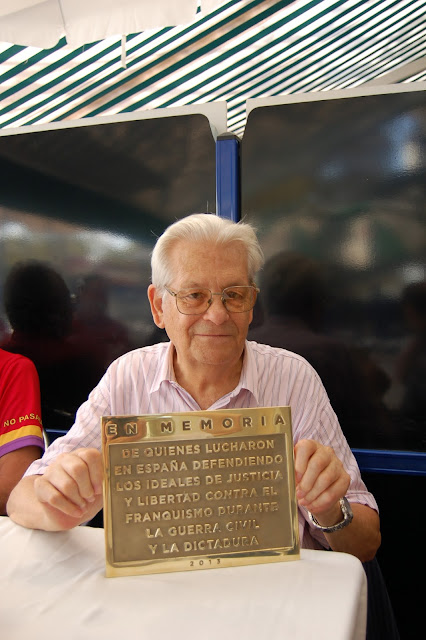
Photo: Jordi Socías